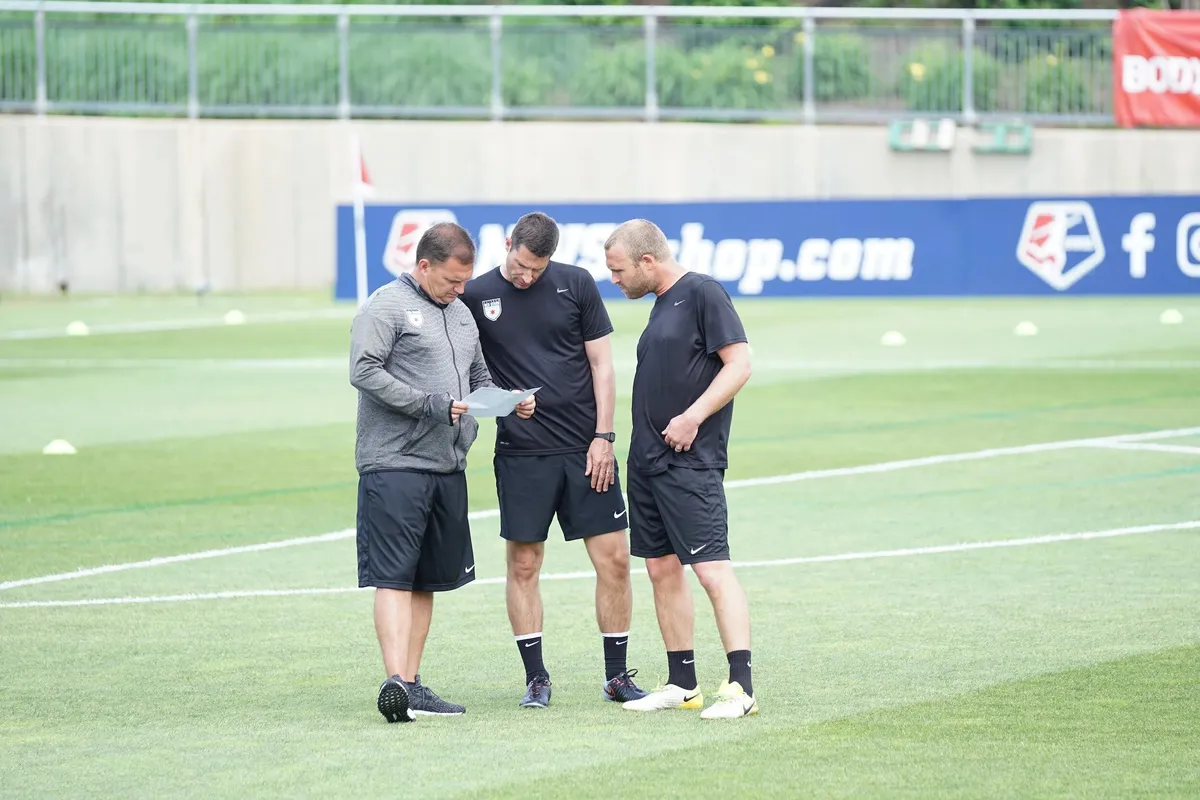




Football player kicking ball in stadium

Elite Sport Tracks the Squad.
Twinspire Studies the Individual.

GPS data.Strength data.Physio notes.Biomechanical measurements.Neuromuscular signals
The data exists, but it has never been unified into a longitudinal model of a single athlete. Twinspire builds a model that adapts as the athlete changes, so every decision is made against that player's own evolving baseline.built on five years of DTU research.

Alexandra Institute
DTU
Myoact
Beyond Beta
DIF Innovation Lab
DTU Skylab

You're Making Sunday's Decision with Tuesday's Data.

1

The Unresolved Decision

GPS in one platform. Strength data in another. Clinical notes remain local. Wearable signals often never leave the athlete’s own device. The challenge in elite sport is no longer access to data alone, but the absence of a coherent longitudinal model of the individual athlete across contexts and over time.

2

The Return-to-Play Gap

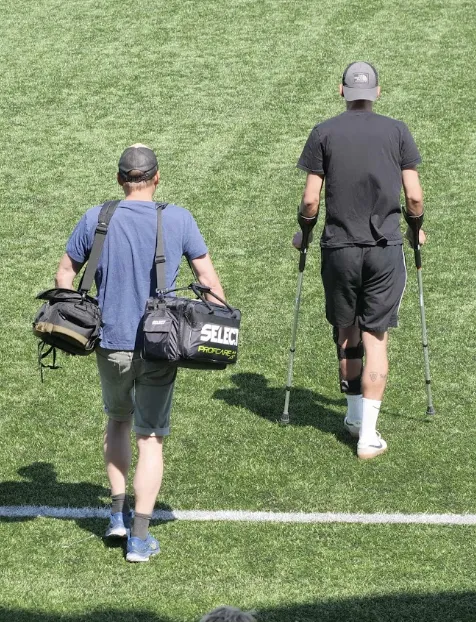
Football injury epidemiology is well established through long-running cohort studies, including the UEFA Elite Club research, which spans thousands of players across multiple countries and seasons. Yet despite increasingly sophisticated monitoring environments, the central decision problem remains unresolved: how to interpret changing signals at the individual level when decisions about return to training, return to play, and load modification must be made under uncertainty.

3

Recurrent Injuries

Subsequent and recurrent injuries continue to represent a meaningful part of the burden in professional football, and the period following return remains especially sensitive. The gap is therefore not simply one of data collection, but of individualized interpretation.

From Population Averages to Individualized Dynamics

Digital twin framework

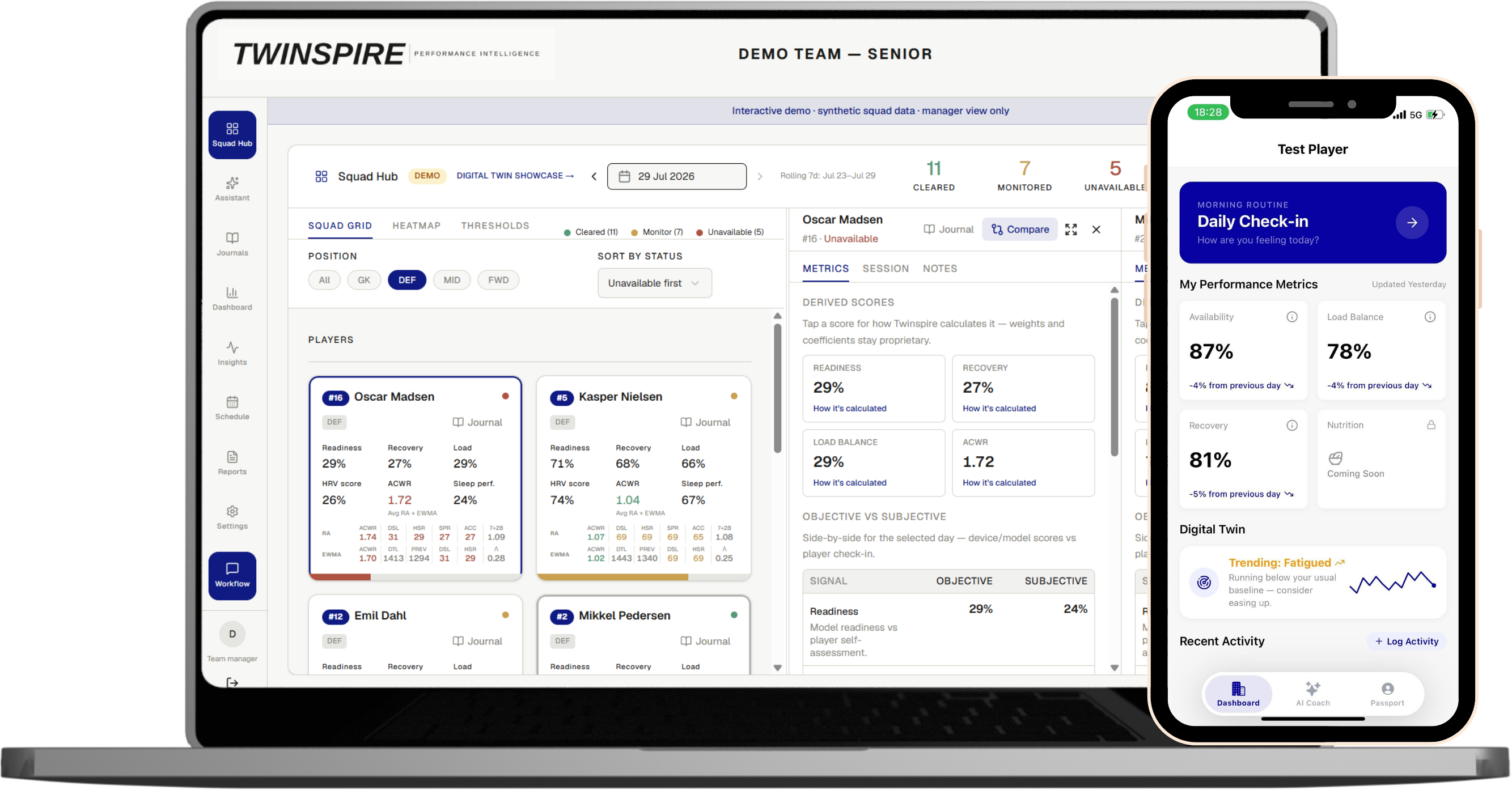
Twinspire is developing a research-based digital twin framework for individualized athlete modeling. The system integrates longitudinal data from multiple sources, including training load, neuromuscular testing, clinician input, and wearable-derived physiological measures.

Approach

The approach combines principles from computational motor control, adaptive nonlinear systems, system identification, longitudinal sequence modelling, and self supervised learning to identify individualized representations of how an athlete’s physiological and functional state changes over time.

Structured data layer

In parallel, Twinspire is building a structured data layer that links sessions, tests, symptoms, and contextual information into a portable athlete history, supporting continuity and decision-making across performance and rehabilitation.

From Research Prototype to Applied Validation

A research prototype has been developed across mobile and web environments, designed to integrate heterogeneous data with minimal input from practitioners. The system now enters real-world validation, focusing on whether it remains usable, robust, and interpretable within elite performance settings.

The current work addresses three questions:

  • Are workflows operationally usable for staff?

  • Do data pipelines provide sufficient quality and continuity?

  • Do the signals support meaningful individualized modeling in practice?

Product mockup

Most systems describe load. Twinspire is being developed to model individual response.

01

Individualized Modeling

Most systems describe load. Twinspire is being developed to model individual response. The research draws on adaptive systems and individualized state estimation to understand how each athlete responds over time.

    Modeling illustration
    02

    Multi-Signal Analysis

    The goal is to establish a personalized reference state and detect meaningful deviations from it. The methodology investigates how multimodal data can be used to model evolving physiological and neuromuscular dynamics.

      Signals illustration
      03

      Validation & Risk Reduction

      The current phase focuses on validating the approach and resolving key uncertainties before broader deployment.

        Validation illustration

        Current Research Questions

        1. 01

          How early can deviations from baseline be detected?

        2. 02

          What data is required to establish a reliable individualized model?

        3. 03

          How do missing data and changing contexts affect robustness?

        4. 04

          Can compensation patterns be identified before symptoms emerge?

        Who We Work With

        We are currently reaching out to clubs, clinics, and performance institutions to participate in our research validation study.

        Footballers

        Footballers

        Your body has been generating data your whole career. Most of it has disappeared. This research aims to establish whether a structured data passport can change that and give you ownership of your own athletic history.

        Coaches & Performance Staff

        Coaches & Performance Staff

        Help us understand how readiness modeling integrates into real decision-making environments, and where the model's outputs are and aren't actionable.

        Physiotherapists

        Physiotherapists

        Co-develop unified deviation-alert and recovery-signal workflows grounded in multi-source data. Help us understand what a clinically useful signal actually looks like in practice.

        The Research Came First. The Team Was Built Around It.

        The project is supported by a dedicated research team of four based at DTU, contributing specialisms in physiological modeling, data engineering, biomechanics, and neuromuscular analysis. Their work forms the scientific backbone of the validation studies currently underway.

        Pouya Tobias Strand Nikoui

        Pouya Tobias Strand Nikoui

        Founder & CEO

        Pouya Tobias Strand Nikoui

        Pouya Tobias Strand Nikoui

        Founder & CEO

        LinkedIn

        Twinspire began from his direct experience with injury and rehabilitation in elite football, which exposed the gap between available data and the quality of individualized decision support. He leads the overall research translation, strategic direction, and external partnerships around the project.

        Prof. John Paulin Hansen

        Prof. John Paulin Hansen

        Co-Founder & Head of Research

        Prof. John Paulin Hansen

        Prof. John Paulin Hansen

        Co-Founder & Head of Research

        LinkedIn

        Professor at DTU Health and lead of the neuromuscular research environment from which the project emerged. His group has worked for several years on digital twin methodology for physiological systems, and this research forms the scientific foundation and institutional anchor of Twinspire.

        Daryan Kamalifar

        Daryan Kamalifar

        Co-Founder & Lead Developer

        Daryan Kamalifar

        Daryan Kamalifar

        Co-Founder & Lead Developer

        LinkedIn

        Platform architecture & data integrations.

        Roxane Maar

        Roxane Maar

        Co-Founder & COO

        Roxane Maar

        Roxane Maar

        Co-Founder & COO

        LinkedIn

        Sports-tech research & institutional partnerships.

        Christos Andreas Ntemkas

        Christos Andreas Ntemkas

        Cloud & Cyber Security Engineer

        Csongor Tarnai

        Csongor Tarnai

        DevOps Engineer

        Hajar El Mhassani

        Hajar El Mhassani

        Intern Full Stack Developer

        Nicola Stefani

        Nicola Stefani

        Research Team

        Hilmar Snær Örvarsson

        Hilmar Snær Örvarsson

        Research Team

        Advisory Board

        Kim Kragbæk Larsen

        Kim Kragbæk Larsen

        Market & Commercialization Strategy (post-project)

        Kim Kragbæk Larsen

        Kim Kragbæk Larsen

        Market & Commercialization Strategy (post-project)

        LinkedIn

        Market & Commercialization Strategy (post-project).

        Athlete Data Must Be Handled and with Responsibly, Transparently, Clear Boundaries.

        Twinspire is being developed with data governance and research ethics as core design principles.

        Core Principles

        The current phase is focused on scientific validation, with attention to lawful processing, traceability, transparency, and responsible handling of longitudinal athlete data.

        Governance & Compliance

        The project is built around GDPR-aligned data practices, EU-based hosting and processing, relevant data processing agreements, and research workflows designed to support clear governance across clubs, practitioners, and athletes. Where appropriate, research data management is structured in accordance with FAIR principles.

        Research Disclaimer

        Twinspire is a research-stage decision support prototype. It is not intended to diagnose, treat, or replace clinical judgment.

        FAQ

        Answers to the most common questions about Twinspire, our methodology, and how clubs can get started.

        Twinspire is an AI-powered decision support platform for football clubs. It builds a continuously updated physiological model of each player by drawing on GPS data, strength output, neuromuscular sensor data, physio notes, and the athlete's own wearables, and alerts medical and coaching staff when something shifts. The goal is to catch the warning signs before an injury becomes a reinjury.

        Alexandra Institute
        DTU
        Myoact
        Beyond Beta
        DIF Innovation Lab
        DTU Skylab